
Woodson Parole and Probation Terms
Parole, post-release supervision, and probation do not describe the same legal status. Modern Kansas sentences are generally determinate for crimes committed on or after July 1, 1993. In those cases, a sentenced person usually serves the prison portion, less credits that apply, and then enters post-release supervision. That transition is generally not a discretionary parole grant. Parole mainly concerns older indeterminate sentences and specific statutory exceptions. Probation comes from a court order and can begin without any state-prison stay.
The source also affects what “released” means. A Woodson Detention Center release timestamp closes a county booking. It may reflect community release or a transfer. A KASPER movement from prison to a parole office supports release from physical prison custody, but supervision continues. “Discharged” is different again: it marks the end of the state correctional obligation shown in that record.
| Status | How it begins | Best Woodson County check | What it does not prove |
|---|---|---|---|
| Parole | Release in an eligible old-law or exception case | KASPER status, movement, and maintaining office | Full discharge or present home address |
| Post-release supervision | Follows the prison term of a modern determinate sentence | KASPER supervision type and office | That all correctional authority has ended |
| Probation | Woodson County court order | Court docket, Court Services, or 31st Judicial District Community Corrections | A prior release from state prison |
| Discharge | Successful completion or other legal end of the obligation | KASPER and the controlling discharge or termination record | The exact earlier date physical custody ended |
- Maintaining office
- The parole office identified in an individual KASPER record as responsible for supervision.
- Absconder
- A recorded supervision noncompliance status. It is not a new conviction and does not state a current location.
- Revocation
- A legal or administrative action that can return a supervised person to custody after a violation.
- Discharge
- The end of the correctional obligation shown in the governing record, not merely release from a jail or prison building.
Verify Woodson Post-Release Supervision
Begin with the Kansas Adult Supervised Population Electronic Repository, known as KASPER, when a KDOC sentence or supervision record is plausible. It covers people sentenced to the custody of the Kansas Secretary of Corrections since 1980, including people in prison, under post-incarceration supervision, and discharged. It does not cover every person booked at Woodson Detention Center. A short county booking with no KDOC sentence belongs in the sheriff and court channels instead.
- Accept the KASPER disclaimer and search with the full name, birth date, or KDOC number. Use enough identifiers to avoid a name-only match.
- Use Conviction County = Woodson to find qualifying cases that began with a Woodson conviction. Use Supervision County = Woodson for supervision assigned to that county. The fields answer different questions.
- Open the individual record. Read supervision type, dated movements, facility or location field, and the parole office maintaining supervision.
- For parole or a state post-release category, contact the maintaining office shown on the record. Do not rely on an old regional map.
- For Community Corr. or court-ordered probation, check the Woodson court docket and contact the 31st Judicial District office to confirm the assignment.
- Read later court entries for modification, revocation, termination, or discharge. Confirm a current answer with the office that owns the record.
KASPER says its information is refreshed each working day, excluding weekends. A new movement or status may therefore be absent between updates. The broader Woodson County released inmate search explains when a sheriff release timestamp, court order, or federal record is the better source.
The supervision-type filter also needs care. “Parole,” “Community Corr.,” “Discharged,” and “Absconder” are separate choices in KASPER, and each narrows a different record question. A result under Community Corr. may describe court-based supervision rather than release from prison. An older movement can remain visible after the status changes. Record the KDOC number, case number, dated movement, and maintaining office before calling, since those details help the agency distinguish people with similar names.
The KDOC parole-office contact page is the official directory for office verification. The manifest image below shows that office route without assigning Woodson County to an unsupported regional office.

Use the office named on the individual KASPER record, since older materials do not establish a safe current county assignment.
Note: Conviction county identifies the case source; it does not prove where a supervised person lives or where that person returned after release.
Woodson Probation Office Verification
Woodson felony community corrections belongs to the 31st Judicial District, which serves Allen, Neosho, Wilson, and Woodson counties. Direct contact matters because the KASPER disclaimer reports that community-corrections probation events after April 21, 2021 may not display during data modernization. A missing new event is not proof that probation ended. The court docket and assigned office remain essential.
31st Judicial District Community Corrections
Chanute office
740 N. Garfield Avenue, P.O. Box 627
Chanute, KS 66720
620-431-5725 ext. 222
Fax: 620-431-5729
Iola office
1 N. Washington
Iola, KS 66749
620-365-1431
Fax: 620-365-1434
KDOC’s published community-partner list names Troy Smith at the Chanute office and Kevin McGuffin at the Iola office. Those details identify real contact points, but they do not establish which office handles a particular person today. Call first to confirm the current assignment and office hours. Court Services may supervise a probation case that is not placed with Community Corrections.
The Kansas District Court public portal can supply orders for probation, modification, revocation, or discharge. The Woodson County District Court page provides the local court contact. A court order is the legal source for probation status. KASPER may add a Community Corr. record, while the local office can resolve the documented display gap. Keep those sources together rather than treating one missing search result as the end of supervision.
Woodson Parole Absconder Records
KASPER maintains a separate parole-absconder search. Its Woodson filter is labeled “Parole Supervision Location Before Absconding.” That wording is crucial. It identifies the supervision location recorded before the person stopped complying, not the person’s present location, home county, or conviction county. Photo display may help distinguish similar names, but identifiers and the maintaining office still need review.
The official search shown below is the successful manifest image matched to Woodson County parole and probation. It illustrates the precise filter readers must interpret.
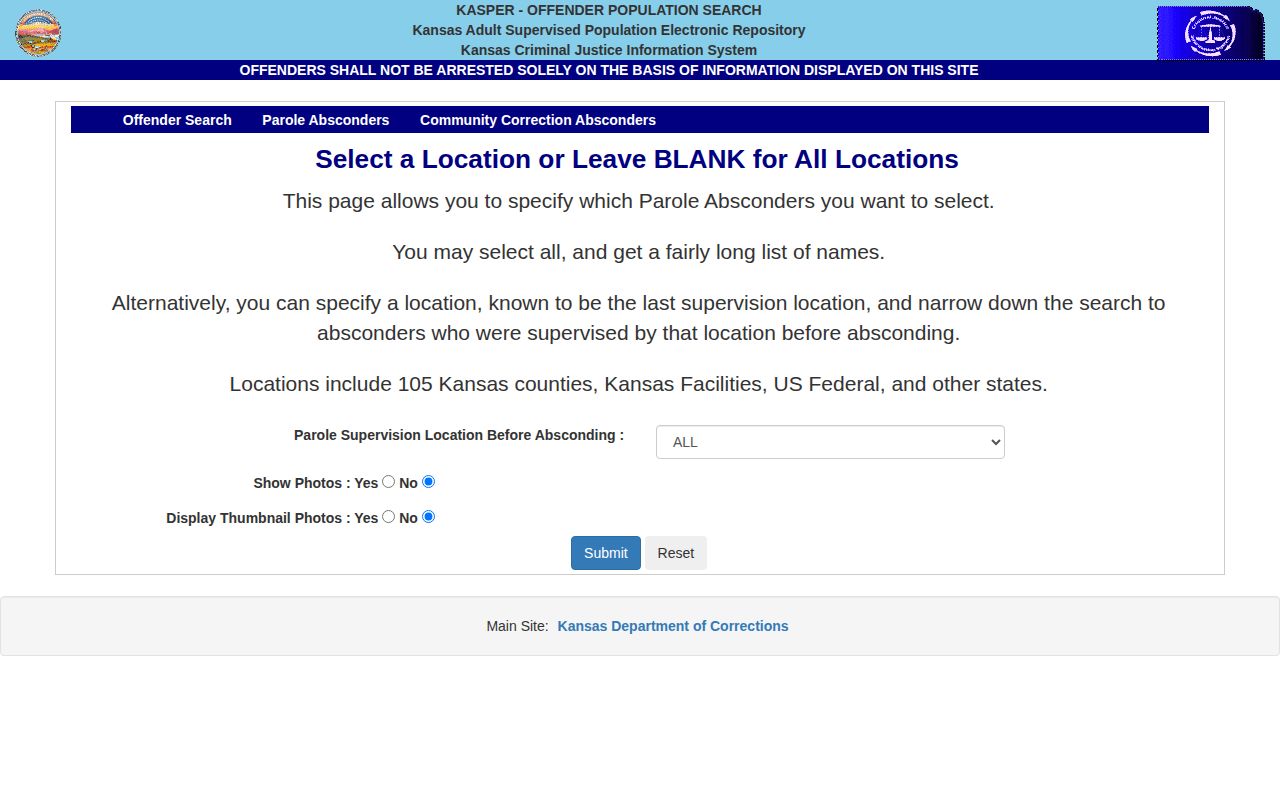
The search refreshes each working day. Confirm status with the assigned office or law enforcement rather than describing the result as live location tracking.
Important: An absconder entry records alleged or established supervision noncompliance. It does not establish a new criminal conviction or show where the person is now.
Woodson Supervision Conditions and Violations
KDOC’s post-release supervision conditions describe the statewide baseline. A released person must report as directed, continue regular reporting, keep residence information current, and obtain advance permission for travel outside the assigned parole district or state. Individual orders can add terms. The exact reporting schedule and conditions must come from the supervising officer or written order, not a general website summary.
A reported violation does not automatically equal revocation. Officers and the governing authority assess the facts and process required for that supervision type. Revocation may return a person to custody, while a modification can change conditions without ending supervision. A new jail booking can also coexist with an older supervision record, so match dates and agencies carefully.
Kansas VINE is useful for a later custody-change notice from a participating agency, but it does not manage probation and should not be presented as a supervision-status registry. KASPER, the court docket, and the maintaining office own the relevant records. If physical custody changes, confirm the event with the sheriff or KDOC source that supplied it.
Note: Reporting frequency and special conditions are individual; only the written order and assigned supervising office can provide a current, complete answer.
When Woodson Supervision Ends
Release from a prison building is only one point in the sequence. A typical modern state case may move from prison confinement to post-release supervision and later to discharge. An eligible older case may move to parole first. Probation follows the court’s order and may end through successful completion, termination, or another court action. Each event has its own date and record owner.
In KASPER, “Discharged” is the strongest public marker that the displayed KDOC obligation has ended. It should not be substituted for the earlier physical release date. Review movements and supervision history to separate those events. KDOC material also describes a maximum sentence discharge certificate as marking the end of the state correctional obligation. For probation, obtain the court’s termination or discharge entry and verify unclear status with Court Services or Community Corrections.
A Prisoner Review Board grant is not proof that physical release occurred. Processing, conditions, or another hold may remain. The later KASPER movement and status are better evidence of the actual transition. Likewise, a Woodson Detention Center release timestamp proves only that the local booking ended. It does not, by itself, show that probation, parole, a detainer, or another agency’s custody also ended.
When records conflict, compare their dates and purposes before drawing a conclusion. The sheriff owns the local custody event. The court owns its probation and revocation orders. KDOC owns state movements, supervision, and discharge. A direct inquiry should name the exact event at issue, because asking only whether someone is “released” can blur prison release, supervision status, and the later end of the sentence.