
Woodson Release Date Meanings
A projected date is a sentence estimate. An actual release date records an event that has already occurred. The difference matters in Woodson County because one person may be in the Woodson Detention Center before trial, another may be serving a local jail term, and a third may be in a Kansas Department of Corrections facility after a Woodson conviction. Only the third person is governed by the statewide KDOC sentence calculation shown in KASPER. The local jail does not use KASPER to set the date for every booking.
A pretrial detainee usually lacks a computed end date. Bond, dismissal, a new court order, resolution of another agency’s hold, or transfer can end the booking. A locally sentenced person may have a calculable date, but the judgment, jail credit, and any applicable local rule must be read together. Research found no published Woodson jail good-time or weekend-release policy, so KDOC’s credit percentages must not be applied to a county jail stay.
Three dates can appear close together without meaning the same thing. A court may enter an order first. Jail staff then complete release processing and record the local timestamp. If the order sends the person to another authority, the Woodson booking ends while custody continues. For a state prisoner, a later KASPER movement can mark the shift from a facility to supervision. Read each date with its source and event label instead of selecting the earliest date as the answer.
Find Woodson Projected Release Dates
Start with the sentence owner, not a broad name search. The Woodson sheriff, the district court, and KDOC maintain different parts of the record. A local booking profile can show the time a past booking ended, but it does not calculate a future prison release. KASPER covers people sentenced to the Kansas Secretary of Corrections since 1980, including current inmates, supervised people, and discharged people. It does not cover every Woodson Detention Center booking.
- Check the Woodson booking and court case to learn whether the person is pretrial, locally sentenced, transferred, or committed to KDOC.
- For a pretrial or local jail case, ask the Woodson County Sheriff’s Office for the booking status and use the Kansas court portal for the bond, judgment, sentence, and jail-credit entries.
- For a state sentence, accept the KASPER disclaimer, search by name or KDOC number, and confirm identity with the case and conviction county.
- Open the individual KDOC record and read “Anticipated release date,” movements, custody status, and maintaining office together.
- When the calculation itself is disputed, contact the KDOC Sentence Computation Unit at 785-296-3317. After the event, verify the movement or release record.
The broader Woodson County released inmate search explains how the local release timestamp, court disposition, KASPER status, and other custody systems fit together. A name missing from the current jail roster is only a clue. It can reflect release, transfer, a data change, or a timing gap.
Kansas Anticipated Release Date
KDOC calls the public KASPER field “Anticipated release date.” That exact phrase is important when asking about a calculation. The date is produced from the sentence record and applicable credits, but KDOC warns that it can change. KASPER may also show conviction and case data, dated movements, current facility placement, supervision type, and the parole office that maintains supervision. “Parole” or post-release supervision means prison confinement has ended while correctional control continues. “Discharged” means the displayed KDOC obligation has ended.
Use Conviction County = Woodson to locate qualifying state cases that arose there. Supervision County = Woodson answers a different question about an administrative supervision assignment. Neither filter proves where the person lives. KASPER updates each working day, excluding weekends, so a newly entered change may not appear at once.
The KDOC field explanation shows how the anticipated date belongs within the full corrections record. It reinforces that a Woodson conviction alone does not make a date final. The sentence, credits, custody moves, and later agency action still control.
Why Woodson Release Dates Change
A date can move for reasons found in the court file, jail-credit record, or KDOC history. Some changes affect sentence length. Others affect whether the person can leave the present facility for the community. A detainer is a request or notice from another authority that may lead to continued custody or transfer. Parole is supervised release used chiefly for older indeterminate Kansas sentences and specified exceptions; it is not the same as modern post-release supervision.
| Record factor | Possible effect | Where to verify |
|---|---|---|
| Amended sentence or court order | Changes the controlling term or legal basis | Kansas district-court case and sentence |
| Concurrent or consecutive terms | Changes how multiple terms combine | Judgment and KDOC computation |
| Credited jail time | Credits qualifying time already served | Judgment, jail-credit entry, and computation |
| Good-time award, loss, or restoration | Moves the state estimate within statutory limits | KDOC record and sentence unit |
| Program completion | May add limited credit for an eligible state prisoner | KDOC program and computation record |
| Detainer, revocation, or transfer | May prevent community release or return the person to custody | Releasing and receiving agencies |
| Old-law parole action | A grant, denial, or later review affects eligible cases | Prisoner Review Board and later KASPER movement |
A parole grant is not proof that a person crossed the gate that day. Processing, conditions, or another hold may remain. Likewise, an end to a Woodson jail booking does not prove that all custody ended. The receiving agency must be checked when transfer is possible.
Data correction can move a date too. KASPER accepts public-data correction reports at kdoc_pub@ks.gov, while sentence-calculation questions belong with the Sentence Computation Unit. A court clerk can provide the judgment but is not the custodian of KDOC’s later arithmetic. The sheriff can confirm a Woodson booking release but does not control a state sentence computation. Sending the question to the office that owns the disputed field avoids mixing these records.
Confirm Woodson Actual Release
For Woodson Detention Center, the sheriff’s rolling 48-hour release feed and individual profile supply the exact local release timestamp. That timestamp proves the displayed booking ended, not that the person entered the community. Read the arresting agency and charges, then call 620-625-8640 if transfer or another hold is the key issue. The Kansas court case can explain a bond order, dismissal, sentence, or probation order, but its event time may precede the jail’s physical processing.
For state custody, wait for the KASPER movement or status update. Kansas VINE can give a prospective custody-change notice for participating records, but an alert is not a permanent release certificate. The VINELink Inmate Search describes the person-match and alert process. Read the event type carefully because a transfer and a community release are both custody changes.
- Anticipated release date
- KDOC’s estimate based on the sentence record and applicable credits.
- Actual release
- The completed custody event documented by the releasing agency.
- Post-release supervision
- A required period of correctional oversight after the prison term.
- Discharge
- The end of the correctional obligation shown in that system.
Kansas Release Credit Limits
For most Kansas crimes committed on or after July 1, 1993, K.S.A. 21-6821 allows up to 15 percent good time. That maximum produces the familiar 85 percent shorthand. It is not a universal promise that every state prisoner serves exactly 85 percent. Good time may be earned, withheld, forfeited, or restored. Conduct, work and program performance, adjustment, release planning, and other KDOC rules can affect the award.
Specified lower-severity cases may receive up to 20 percent. The research identifies nondrug severity levels 7 through 10 for crimes on or after January 1, 2008, drug levels 3 through 4 from January 1, 2008 through June 30, 2012, and drug levels 3 through 5 on or after July 1, 2012. Eligible prisoners serving only specified severity bands may also earn up to 120 days for successful completion of an approved education, vocational, treatment, or risk-reduction program. Offense combinations and sentence limits apply. These are maximum opportunities, not automatic deductions.
The current statute’s official text is shown in the image below.
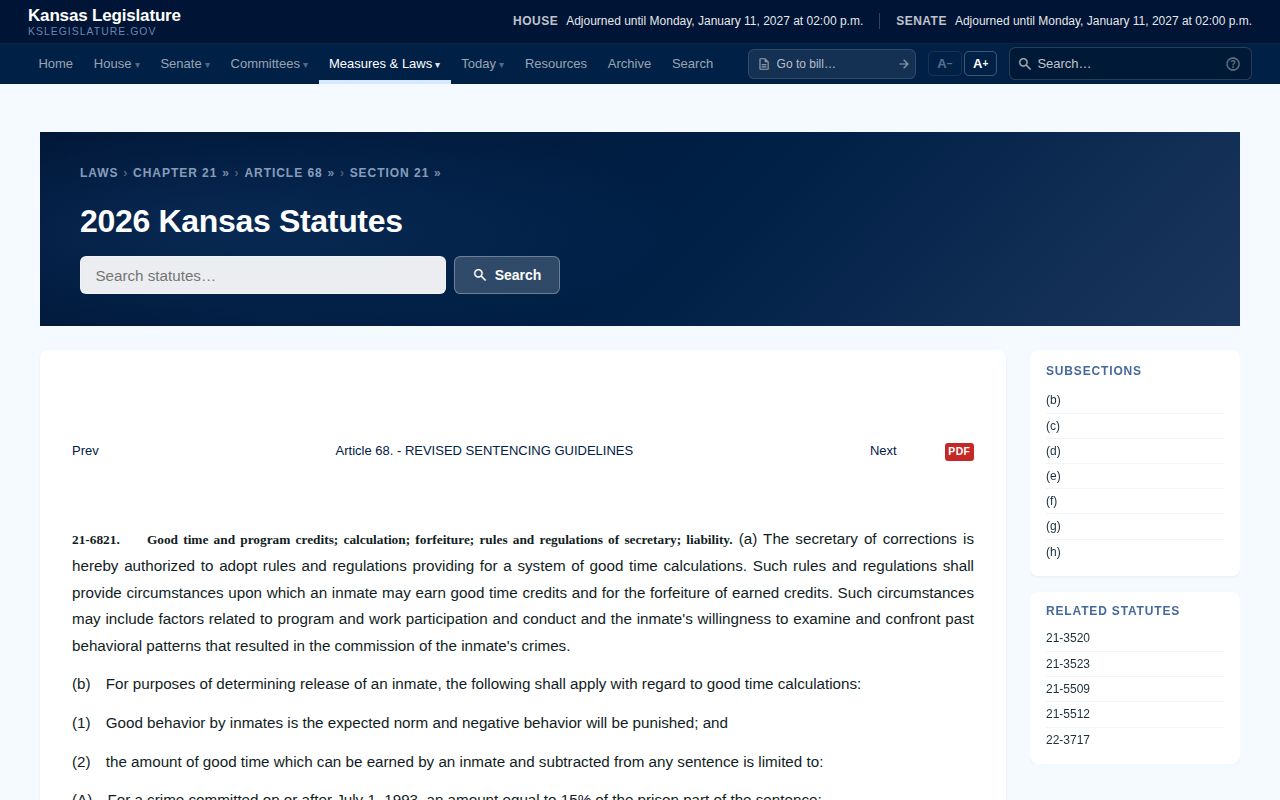
This state-prison framework does not establish a Woodson Detention Center credit policy. Local calculations still require the judgment, jail-credit record, and a direct answer from the proper custodian.
Older Woodson Sentence Rules
Crimes committed before July 1, 1993 follow a different framework. Under K.S.A. 22-3725, sentences of two years or more can receive maximum good time of one-half, while shorter sentences follow the statute’s older rules. Old-law parole eligibility and conditional release therefore cannot be worked out with the modern 15 percent shorthand.
The older statute is available from the Kansas Legislature.
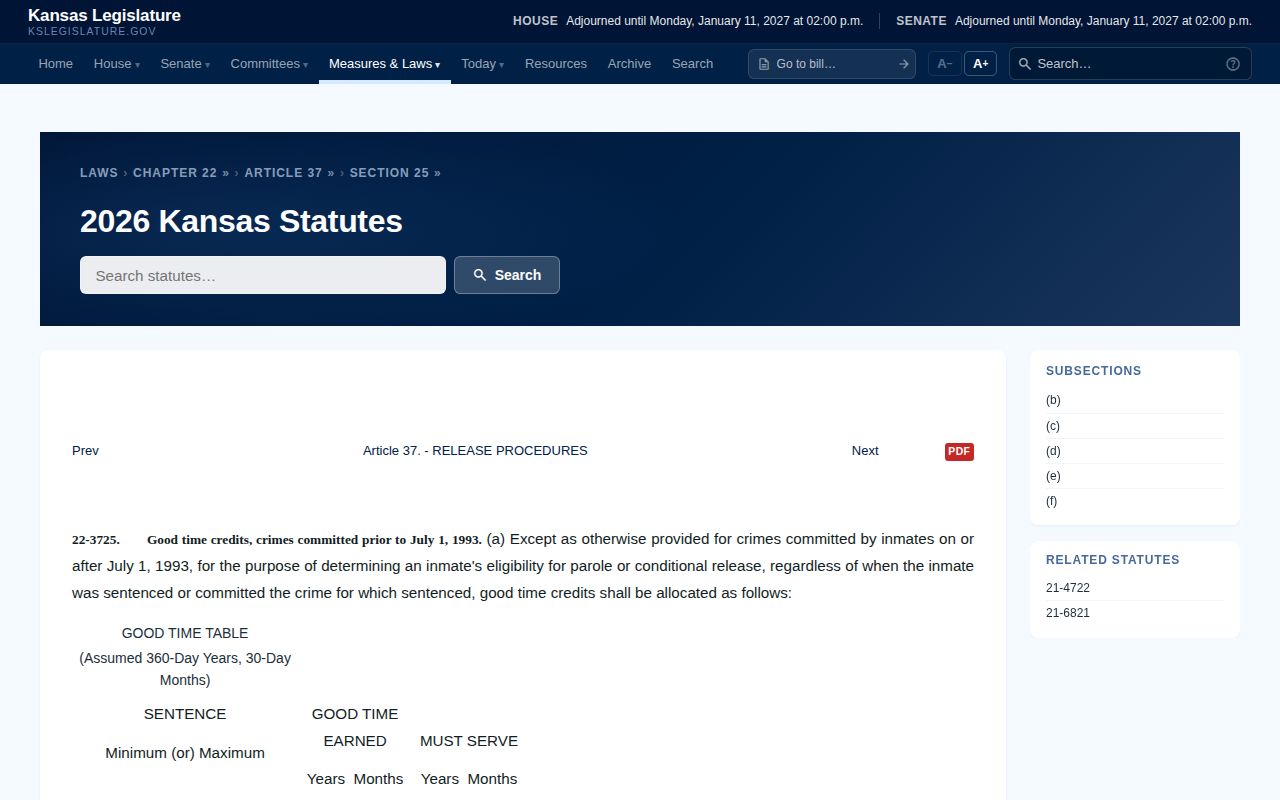
When the offense date places a Woodson case under older law, use the court judgment, KASPER record, and KDOC calculation. Avoid home arithmetic. Retained good time, parole eligibility, board action, and later movement each answer a different part of the release question.
K.S.A. 22-3718 addresses release at the maximum term less earned credits and related supervision and notice. It helps define the legal frame, but the individual agency record remains the source for a named person’s date.
Old-law cases may also involve the Kansas Prisoner Review Board. Eligibility means a case can be considered under the governing law. It is not a finding that release is suitable, and neither term proves physical release. A grant still must be followed by the recorded KDOC movement. Most modern determinate sentences instead lead to post-release supervision after the prison portion, subject to the individual sentence and statutory exceptions.